Executive Summary: The 2026 Search Shift
Search behaviour has undergone a generational transformation. Instead of clicking through ten blue links on Google, users are now asking ChatGPT, Google Gemini, and Perplexity for direct recommendations, side-by-side service comparisons, and trusted business suggestions.
- The Problem: A modern, beautiful website can be completely unreadable to AI search models if business data is trapped inside graphics, service pages are ambiguous, or legitimate AI crawlers like
OAI-SearchBotare blocked. - The Solution: GEO (Generative Engine Optimization) ensures your structured schema, content taxonomy, and technical crawlability allow generative engines to cite and recommend your brand.
- Free Audit Available: You can test your website in 60 seconds with our Free AI Readiness & GEO Checker — 100% free, no login, and unlimited URL audits.
Is Your Website Ready for AI Search?
Think about the last time someone searched online for your service. In previous years, they would type a few keywords into a search bar, scroll through sponsored ads and organic links, and manually visit five or six tabs. Today, decision-makers and everyday consumers alike increasingly type conversational queries into ChatGPT Search, Google Gemini, and Perplexity AI:
“Which web design and IT development company in Delhi NCR has proven experience in custom CRMs and transparent pricing?”
When an AI engine processes that prompt, it doesn't rank sites solely by backlinks or keyword density. It synthesizes real-time web knowledge, crawls trusted public pages, evaluates factual authority, and generates a structured recommendation with source citations.
That fundamental shift raises a pivotal question for every business leader: Can AI search systems understand what your website offers, which locations you serve, and why a client should trust you?
Unfortunately, many businesses discover too late that their websites are practically invisible to AI. Critical information may be locked inside unindexed PDF brochures or flat banners, pricing structures may be vague, or strict server firewalls may inadvertently reject legitimate AI crawlers. If AI systems cannot parse and verify your public data, your business gets skipped during AI-synthesized search results.
Traditional SEO vs. Generative Engine Optimization (GEO) in 2026
To understand why an AI-friendly architecture matters, look at how the search landscape has broadened from traditional SERPs to AI synthesis engines:
| Dimension | Traditional SEO (Google SERP) | Generative Engine Optimization (GEO) |
|---|---|---|
| Search Mechanism | Keyword matching, anchor texts, and backlink graphs. | Semantic comprehension, LLM knowledge retrieval, and real-time citation synthesis. |
| User Output | Ranked list of 10 clickable blue links with meta snippets. | Direct conversational answer, comparative analysis, and footnote source links. |
| Content Evaluation | Header tags, keyword frequency, and bounce rates. | Factual density, clear answers to specific sub-questions, and entity consistency. |
| Crawler Ecosystem | Googlebot, Bingbot. |
OAI-SearchBot, GPTBot, PerplexityBot, ClaudeBot, Google-Extended. |
| Success Metric | Impressions, clicks, and ranking position #1-3. | Brand citation rate, AI recommendation share, and zero-click authority. |
Is Your Website Ready for ChatGPT, Gemini & Perplexity?
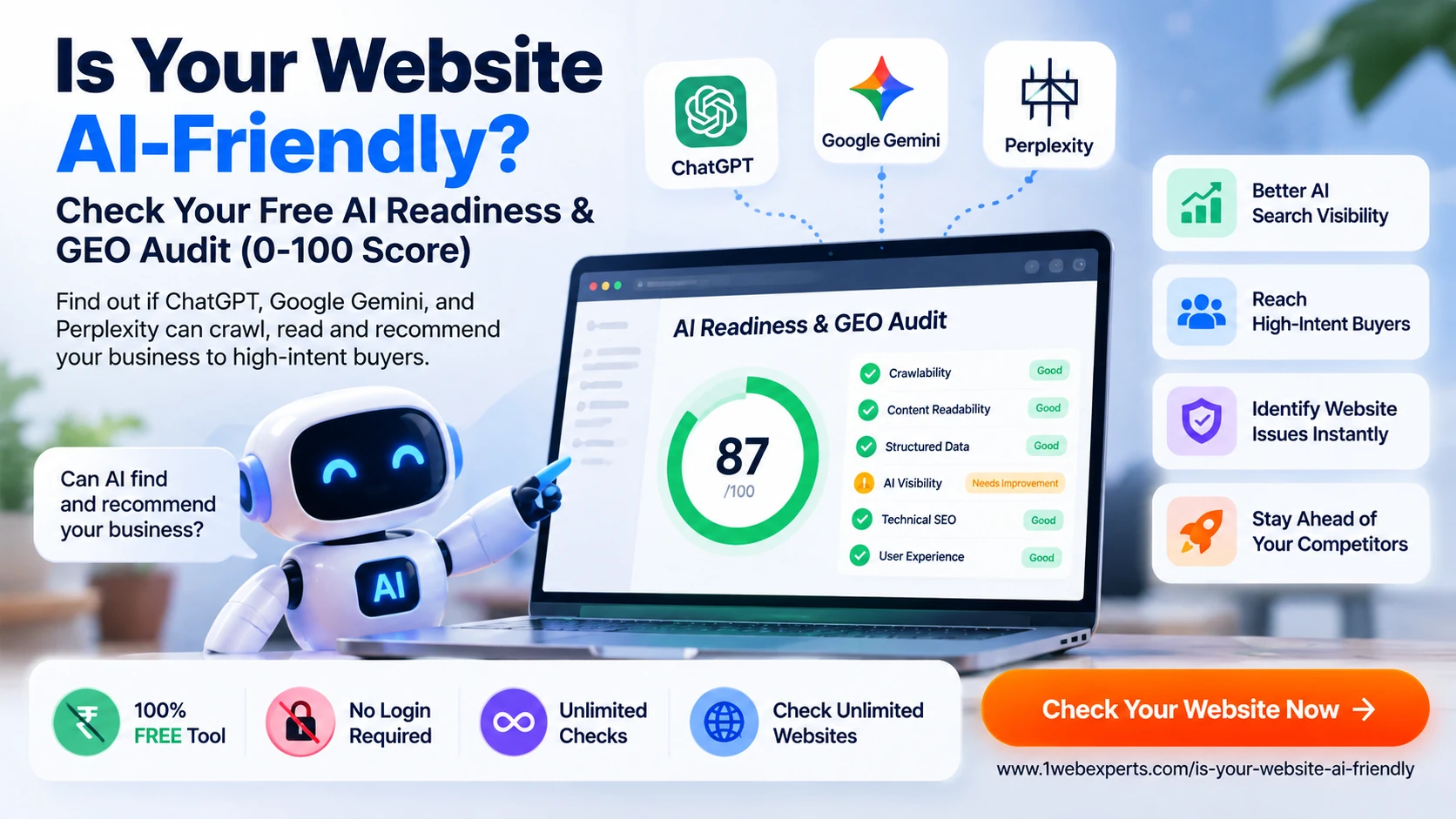
Stop guessing your AI visibility. Get an instant, automated AI Readiness & GEO diagnostic report for your website right now — completely free with no registration required.
Test Your Website URL FreeWhat Exactly Is an AI-Friendly Website?
An AI-friendly website is an online presence engineered so search engines and large language model (LLM) discovery bots can effortlessly crawl public pages, extract structured meaning, and recognize your company's core services, geographic footprint, and industry expertise.
Crucially, AI-friendliness does not mean adding some secret meta tag or keyword-stuffing AI prompts into hidden HTML comments. LLMs are trained to detect and penalize low-quality manipulation. Instead, genuine AI readiness builds directly upon clean web engineering best practices:
- Semantic Content Hierarchy: Clean, logical use of
<h1>,<h2>, and<h3>tags that break complex topics into digestible sub-themes. - Unobstructed Crawler Access: Ensuring your
robots.txtand firewall do not inadvertently block legitimate AI search bots such as OpenAI'sOAI-SearchBot(detailed in OpenAI's official crawler documentation). - Comprehensive Schema Markup: Implementing JSON-LD structured data (
LocalBusiness,ProfessionalService,FAQPage,Article) to feed unequivocal entity relationships directly into search graphs. - Lightning-Fast Load Performance: Sub-second server response times and optimized WebP images so automated bots can crawl your pages within tight timeout windows.
- Transparent Business Facts: Unambiguous NAP (Name, Address, Phone), service areas, pricing guidance, and verified team bios that reinforce EEAT (Experience, Expertise, Authoritativeness, and Trustworthiness).
Many webmasters accidentally block all AI bots in robots.txt to protect content from model training. However, blocking OAI-SearchBot or PerplexityBot prevents ChatGPT Search and Perplexity from indexing your live website for real-time user search queries! You can safely disallow training crawlers while keeping search discovery bots fully open.
How to Check Your Website in 4 Simple Steps
You don't need expensive software or an agency retainer to get an initial diagnostic of your AI visibility. Follow these four simple steps:
Enter Your URL
Input your full public domain (e.g., https://yourdomain.com). No login or account creation needed.
Analyze Score
Receive your AI Readiness & GEO score alongside granular findings on robots directives, schema, and page speed.
Fix Bottlenecks
Resolve technical crawl blocks, sharpen your service copy, and re-audit to benchmark your optimization progress.
Why AI-Friendliness Matters for Your Business Growth in 2026
Whether you operate a manufacturing plant in Greater Noida, an e-commerce brand in Delhi, or a professional consultancy across India, adapting to AI search brings six immediate commercial advantages:
- Crystal-Clear Brand Understanding: AI models don't have human intuition. When your website explicitly defines services, target industries, and location credentials, AI models can accurately categorize and pitch your business to users inquiring about your specific domain.
- Inclusion in High-Intent Recommendations: Users who search via conversational AI frequently have acute purchase intent. Being cited as a top recommended vendor by an AI assistant generates exceptionally qualified inbound leads.
- Reinforces Core Google SEO: Google’s official guidance emphasizes helpful, reliable, people-first content. The technical improvements you make for AI readability — structured schema, sub-second latency, and semantic headers — directly boost traditional Google organic rankings.
- Superior User Experience for Humans: Clear FAQ accordions, transparent pricing breakdowns, and straightforward service descriptions don’t just delight LLM crawlers — they substantially increase conversion rates for human visitors.
- Early Detection of Hidden Technical Flaws: An AI readiness audit highlights broken redirect loops, canonical anomalies, and missing metadata before they erode your search engine rankings.
- Future-Proofing Your Digital Equity: Search algorithms are changing faster than ever. A website engineered with clean semantic code and transparent schema is inherently resilient against future AI engine paradigm shifts.
The 8-Point AI Readiness Checklist
Before publishing new content or launching a website redesign, use this practical checklist to verify your site's generative AI posture:
AI-Friendly Website Verification Checklist
- Robots.txt Whitelisting: Confirm that search discovery bots (
OAI-SearchBot,PerplexityBot,Googlebot) are not disallowed. - Original, Factual Content: Answer direct customer questions concisely instead of padding pages with generic promotional fluff.
- Logical Heading Hierarchy: Maintain a strict
H1 > H2 > H3nested tree with meaningful header labels. - Valid JSON-LD Schema: Validate your
LocalBusiness,Organization, andFAQPageschemas in Google's Rich Results Test tool. - Exact NAP Consistency: Ensure business Name, Physical Address, and Phone Number match perfectly across all footers, contact pages, and Google Business Profile.
- Clean Internal Linking: Connect related sub-services and blogs (such as our in-depth analysis on AI vs Traditional Website Development).
- Text Accessibility: Avoid locking critical phone numbers, pricing tables, or service lists inside raster images where crawlers cannot read them.
- Core Web Vitals Compliance: Achieve mobile load speeds under 2 seconds and minimal Cumulative Layout Shift (CLS).
Does a High AI Readiness Score Guarantee Recommendations?
No — and any agency that promises guaranteed AI citations is misleading you.
An AI readiness audit score is an objective diagnostic measurement of your website's crawlability, content clarity, and technical integrity. It ensures that when an AI model searches the live web for services in your category, your website presents zero technical or semantic barriers.
However, generative responses also depend on dynamic user prompts, real-time context, geographic location, and competitive density. Treat your AI score as a reliable compass for continuous technical refinement, not a static badge.
Frequently Asked Questions (FAQ)
Is the 1Web Experts AI Readiness & GEO Audit really 100% free?
Yes, absolutely. You can run checks across as many website URLs as you require without paying any fee or entering credit card details.
Do I need to sign up or provide website passwords?
No login or registration is required. You only input the public URL of the webpage you wish to inspect. We will never ask for your hosting, CMS, or server credentials.
Can I test my competitors' websites with this tool?
Yes. Since the audit analyzes publicly accessible HTTP responses and schema code, you can test competitor websites to benchmark their AI readiness against yours.
How does GEO differ from standard SEO services?
While standard SEO targets keyword rankings on traditional search engine results pages, GEO (Generative Engine SEO) optimizes content structure so generative AI chatbots (ChatGPT, Gemini, Claude, Copilot) can cite your business in synthesized answers.
What should I do after receiving my audit report?
Start by correcting critical crawl restrictions in your robots.txt, adding rich schema markup, and expanding thin service copy. If you need technical assistance, our specialized website development and AI business solutions teams can implement full-scale optimizations for you.
Ready to Make Your Website AI-Ready?
Take the guesswork out of modern search. Audit your site for free today or consult directly with our web engineering team in Patparganj, Delhi NCR.