Executive Summary
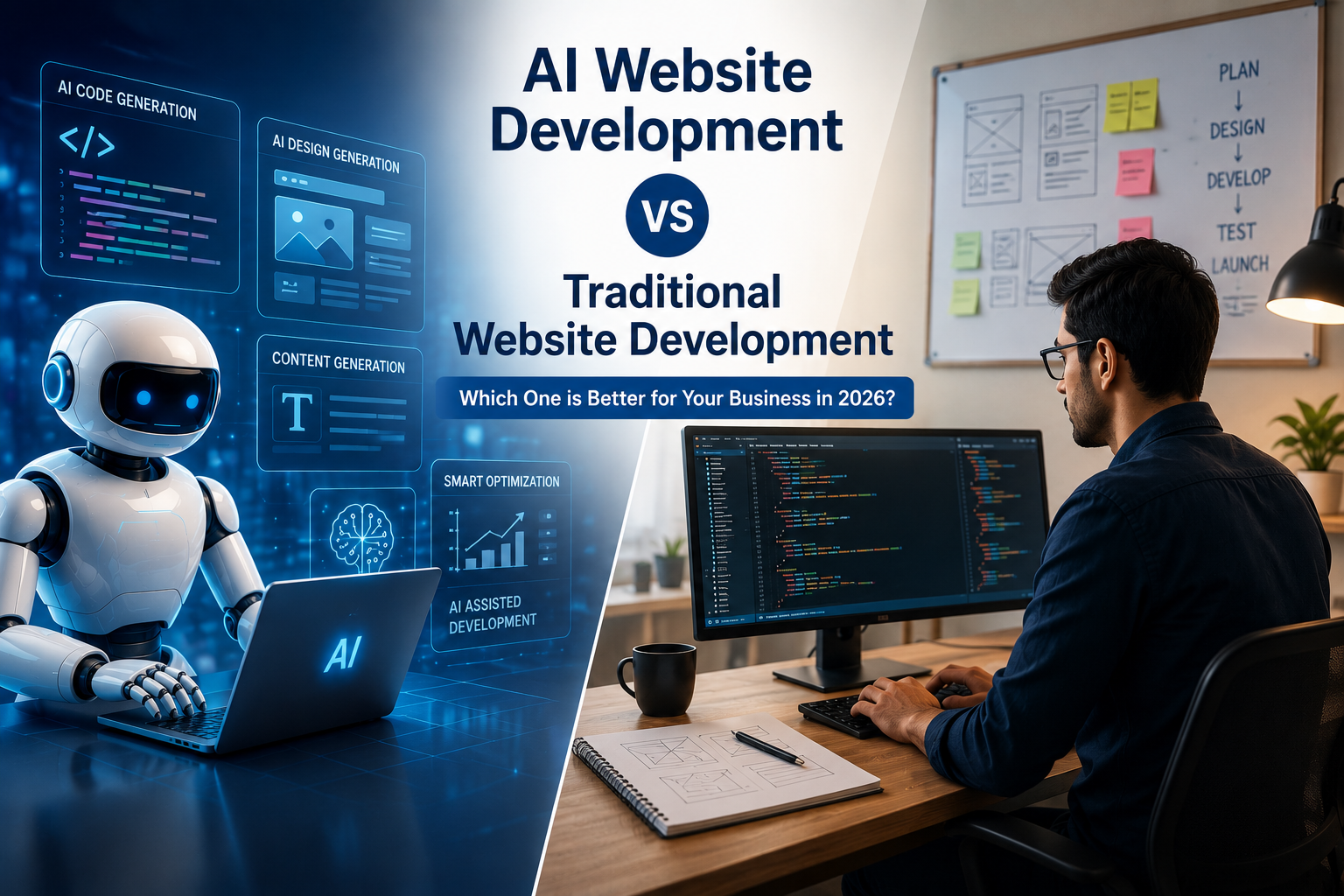
Artificial Intelligence has transformed website development in 2026. But here is the plain truth: AI is not replacing developers - it is supercharging them. While AI tools slash development hours on boilerplate coding and rapid prototyping, traditional engineering remains indispensable for enterprise security, bespoke database architecture, and custom business logic. The highest-performing Indian businesses combine both: the speed of AI with the strategic precision of experienced web engineers.
Key Takeaways
- Speed vs. Control: AI tools accelerate prototyping by 40-60%, but lack situational context for custom business rules.
- Security Reality: Over 40% of unreviewed AI-generated code snippets contain hidden security vulnerabilities or inefficient loops.
- Traditional Engineering Strength: Custom ERPs, multi-vendor e-commerce, and high-load web portals still require rock-solid manual architecture.
- The 2026 Hybrid Model: The fastest and most cost-effective path is using AI-assisted tools governed by seasoned full-stack developers.
What is AI Website Development in 2026?
AI website development refers to using artificial intelligence tools (such as Large Language Models, neural UI generators, and automated code assistants) to accelerate the creation of websites. Instead of typing every single line of boilerplate CSS or setting up repetitive database schemas by hand, developers leverage AI assistants like GitHub Copilot, Cursor, ChatGPT, and Claude to build faster.
Crucially, AI in 2026 is an accelerator, not an autonomous replacement. It acts like high-octane fuel in the hands of an expert driver. In the hands of an amateur, however, it frequently produces bloated code, broken responsive layouts, and critical security loopholes.
Teams leveraging AI-assisted coding report delivering MVPs 35% to 50% faster. However, projects that skipped manual code review experienced a 2.8x higher post-launch bug rate compared to traditional builds.
The AI-Assisted Website Development Process
In modern web studios, AI seamlessly integrates into the development pipeline across six distinct stages:
1. Rapid Architecture & User Stories
AI structures complex project requirements, suggests database relationships, and helps map out frictionless customer conversion journeys.
2. Wireframing & Design Iteration
Designers use AI tools to quickly test color schemes, font pairings, and responsive component mockups in minutes instead of days.
3. Accelerated Frontend & Backend Code
Autocomplete coding assistants write routine CRUD operations, API endpoints, and clean Tailwind/CSS utilities, saving dozens of manual hours.
4. Search-Intent Content & Meta Structuring
Drafting meta descriptions, FAQ schemas, and semantic topic clusters. Senior human copywriters then refine every line to ensure genuine brand voice.
5. Automated Testing & Bug Catching
AI scans codebases for broken links, syntax errors, and accessibility contrast issues before human QA teams perform stress testing.
6. Performance & Core Web Vitals Tuning
Algorithms analyze page load bottlenecks, optimize script execution orders, and monitor real-user metrics to maintain sub-2 second load speeds.
The Dangerous Myth: “AI Builds Professional Websites Without Developers”
One of the most persistent myths floating around the internet today is that a business owner can type a 2-sentence prompt into an AI tool and receive a ready-to-launch corporate website. Here is what actually happens when you try to build without an experienced developer:
- Zero Custom Business Logic: AI website builders cannot configure custom GST invoice generation, complex CRM webhooks, multi-tier pricing, or proprietary Indian payment gateway integrations (Razorpay, Cashfree, PayU) without breaking.
- Code Bloat & Terrible Page Speed: Pure no-code AI generators inject thousands of lines of unneeded inline scripts, resulting in abysmal Google Core Web Vitals scores and high mobile bounce rates.
- Security Vulnerabilities: AI lacks situational awareness regarding SQL injection defenses, CSRF tokens, and sanitized inputs. A single unpatched flaw puts customer data at risk.
- No Intellectual Property Ownership: Many online AI page generators lock you into proprietary hosting ecosystems where you cannot export or migrate your own source code.
What is Traditional Website Development (And Why It Still Rules Enterprise)?
Traditional website development is the proven, engineering-first approach. Experienced full-stack developers, UI/UX designers, and QA engineers build your digital platform from the ground up using custom HTML, PHP, Laravel, React, or clean WordPress architectures.
Unlike automated builders, every architectural decision - database indexing, server caching headers, security firewalls, and checkout flows - is tailored precisely to your company's operational needs. It remains the gold standard for custom business software, corporate websites, and enterprise web applications.
Direct Head-to-Head Comparison: AI vs. Traditional
| Key Parameter | Pure AI / No-Code | Traditional Development | 1Web Experts Hybrid Model |
|---|---|---|---|
| Delivery Timeline | 1-3 Days | 4-8 Weeks | 7-14 Days |
| Custom Business Logic | Severely Limited | 100% Bespoke | 100% Tailored & Scalable |
| Google Speed & CWV | Poor to Average (40-60) | High (90+) | Ultra-Fast (95-100) |
| Security & Compliance | Unverified & Risky | Enterprise-Grade | Audited Security Standard |
| Code Ownership | Platform Locked | 100% Client Owned | 100% Full Source Code Rights |
The Verdict: Which One Should Your Business Choose in 2026?
The choice is not about picking AI or Traditional development. The winning businesses in Delhi NCR and across India are leveraging the Hybrid Synergy:
- Choose Pure AI Prototyping if: You are a college student building a weekend concept or testing an idea that requires zero customer data or transactions.
- Choose Pure Traditional Development if: You are a bank, hospital, or government entity with rigid compliance requirements where no third-party LLMs may touch source code.
- Choose the AI-Powered Custom Approach if: You are an ambitious business, manufacturer, startup, or service provider looking for a fast, visually stunning, custom-coded website that drives inquiries without paying exorbitant corporate agency retainers.
Continue Reading: Part 2 is Now Live
Ready to explore real-world cost comparisons, speed tradeoffs, customisation limits, cybersecurity precautions, and how to choose the right approach for your business in 2026?
Read Part 2: Cost, SEO, Security & Which Approach is Right →