Executive Summary
AI tools have dramatically lowered the barrier to getting a prototype online, but building a production-ready website that converts, scales, and protects customer data remains an engineered craft. In this guide, we break down the practical differences between AI-assisted and traditional custom development across cost, launch speed, customisation, SEO performance, cybersecurity, and long-term maintenance to help you select the exact strategy for your business goals in 2026.
Key Takeaways
- Headline Cost vs Total Cost: AI builders look cheap upfront, but post-launch workarounds, CRM integrations, and eventual rebuilds often exceed custom development investments.
- Speed with Substance: AI accelerates drafting and repetitive code by 50%, but human oversight ensures the final product is mobile-responsive, error-free, and high-converting.
- SEO Ranking Reality: Google ranks pages based on usefulness, speed, and technical architecture, not whether AI was involved. Automatically generated thin content risks severe penalties.
- Security Due Diligence: AI-generated code snippets can contain unseen vulnerabilities. Production systems demand strict human peer review and dependency testing.
- The 2026 Winning Formula: The smartest organizations adopt a hybrid model: leveraging AI for rapid drafting while relying on experienced full-stack engineers for architecture, security, and growth.
AI vs Traditional Website Development: The Real Difference for Businesses
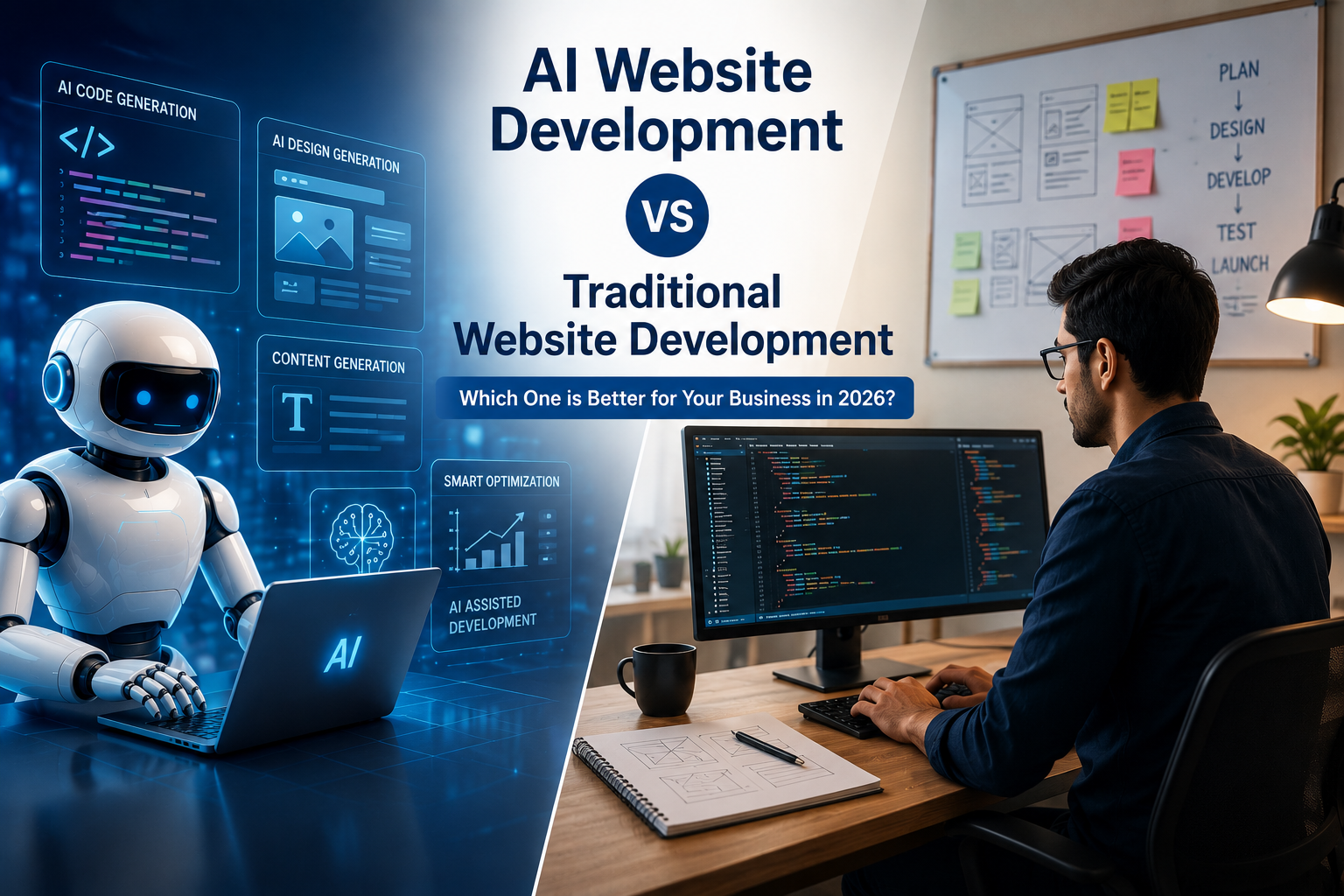
AI has made it easier to get a website started. A business owner can use an AI website builder to create a first draft, generate page copy or explore design ideas in less time than before. That is undeniably useful, especially when time and budget are tight.
However, getting a website online and building one that actively powers and protects a business are two completely different jobs. A business website must explain complex services, capture qualified leads reliably, synchronize with your CRM, protect customer financial data, load under 2 seconds, and turn casual visitors into loyal clients. Those requirements call for far more than a quick template design.
In Part 1, we examined how AI supports modern web development pipelines. Here in Part 2, we compare AI-assisted and traditional development across the critical metrics that determine business success.
1. AI vs Traditional Website Development: Quick Comparison
2. Which Approach Costs Less?
AI tools can significantly reduce the hours required for boilerplate tasks, which may lower the initial price tag of a straightforward website. A local retail business that only needs a contact form, about page, and service list can leverage AI to deploy a functional first version on a lean budget.
However, the initial quote is rarely the total cost of ownership. After launch, every successful business requires ongoing enhancements: new landing pages, conversion analytics, third-party CRM hooks, payment gateway updates, performance tuning, and user interface iterations. A low-cost AI build quickly becomes expensive if the underlying codebase is unstructured spaghetti that cannot be maintained, forcing a costly complete rebuild six months later.
When evaluating web proposals, confirm what is included: custom UI/UX design, mobile responsiveness across all viewport breakpoints, on-page SEO schema, Google Analytics & Tag Manager setup, security hardening, full source code ownership, and post-launch maintenance SLA.
3. Speed: Launching Quickly Without Rushing Critical Engineering
AI assistants help developers produce wireframes, test component styles, write routine queries, and identify syntax errors in seconds. That dramatically shortens the initial development cycle. But speed cannot replace the fundamental steps of understanding your audience, auditing content accuracy, testing checkout flows, and validating security on real devices.
Traditional web development follows a disciplined engineering progression: Discovery → Wireframes → Custom UI Design → Modular Coding → Cross-Browser QA → Production Launch.
The crucial question is not simply, “Which method is faster?” It is, “Which method delivers a reliable website that achieves business goals on a realistic schedule?” A rapid 48-hour launch is pointless if your contact form drops customer leads or the layout breaks on mobile screens.
4. Customisation and Functionality: Templates Have Rigid Limits
A template or AI-generated layout is a sensible starting point for generic informational sites. But walls appear rapidly when you need custom functionality: bespoke quotation calculators, multi-step customer onboarding, role-based client portals, dynamic inventory filtering, or two-way synchronization with your ERP system.
Professional custom website development provides total control over database schemas, API architecture, and micro-interactions. This distinction is critical for e-commerce websites with complex shipping rules, B2B portals, or businesses where the web platform is the primary revenue engine.
5. SEO: Can an AI-Built Website Rank on Google in 2026?
Yes, an AI-assisted website can rank well on Google. Google has repeatedly clarified that search rankings are not based on whether AI was used during creation. Google prioritizes pages that are original, helpful, factually reliable, and technically sound.
However, AI content generation introduces serious SEO hazards if unmonitored:
- Hallucinations & Inaccuracies: AI frequently invents facts, phone numbers, or outdated policies.
- Lack of Real E-E-A-T: Google values Experience, Expertise, Authoritativeness, and Trustworthiness. Generic AI summaries lack proprietary case studies and real project proof.
- Search Spam Penalties: Mass-publishing hundreds of AI-generated pages to target keyword permutations violates Google’s Helpful Content and search spam policies.
Solid search engine optimization (SEO) must be baked into the website architecture from day one: clean semantic HTML5, descriptive meta tags, fast Core Web Vitals, JSON-LD Schema markup, and crawlable internal linking hierarchies.
6. Cybersecurity and Reliability: Code Review Matters More Than the Tool
Security is never automatic in either AI or human development. If your website handles client contact details, customer accounts, payment processing, or confidential trade inquiries, security must match your liability.
Generated AI code frequently pulls deprecated libraries, creates unescaped SQL queries, or misses CSRF token validations. A robust development process requires rigorous code review, updating npm/composer dependencies, validating all inputs, implementing strict SSL/TLS, enforcing Content Security Policies, and isolating administrative endpoints.
7. Scalability and Long-Term Maintenance
A website that serves a 5-person team today might need multi-currency billing, additional languages, custom webhooks, or localized landing pages next year. Planning for growth does not mean over-engineering on day one - it means building on a modular stack that adapts without tearing down the existing infrastructure.
Experienced full-stack developers build modular architectures (such as Laravel, clean modular PHP, or modern headless stacks) where individual components can be upgraded seamlessly without breaking production.
8. Which Option Is Right for Your Business?
Choose AI-Assisted Development If:
- You need a straightforward informational brochure website.
- You are validating an early startup idea or MVP prototype.
- Your requirements are simple and involve zero custom third-party integrations.
- You have in-house talent to review content, accessibility, and security before launch.
Choose Traditional / Hybrid Custom If:
- Your website is central to lead generation, daily revenue, or brand reputation.
- You need bespoke workflows, custom calculators, or secure client portals.
- Your company requires strict compliance, data protection, and audited code quality.
- You expect long-term scale and need 100% full ownership of your source code.
9. Does AI Replace Website Developers in 2026?
AI is transforming the tools developers use, but it cannot replace human understanding of business objectives, brand nuance, and technical accountability. A successful website requires someone who understands customer psychology, resolves contradictory requirements, and stands behind the quality of the final product.
Skilled web engineers treat AI like a power tool: they use it to accelerate execution, while applying rigorous human judgement to architecture, cybersecurity, and user conversion.
10. Questions to Ask Before Choosing a Web Development Agency
- Scope & Pricing: Exactly what deliverables are covered in the quoted fee and timeline?
- Mobile & Accessibility: Will the site be tested on real iOS, Android, and desktop screen sizes?
- Technical SEO: Are Schema markup, XML sitemaps, OpenGraph tags, and Core Web Vitals included?
- Security Posture: What SSL certificates, firewall rules, and automated backup routines are in place?
- Ownership: Will your business have full administrative access to source code, domain, and server credentials?
- Support & Warranty: What maintenance and debugging assistance is provided after deployment?
Ready to Build a High-Performing Website for Your Business?
At 1Web Experts, we combine the rapid drafting efficiency of modern AI tools with 9+ years of full-stack engineering expertise. Whether you need a bespoke corporate platform, an e-commerce store, or a high-converting lead engine, we build digital assets designed to scale.
Frequently Asked Questions
Is AI website development better than traditional website development?
Neither approach is universally better. AI-assisted development offers faster prototyping and lower costs for basic brochure sites, while traditional custom engineering provides unmatched security, scalability, and flexibility for complex business operations. The best solution is often a hybrid of both.
Can an AI-built website rank on Google?
Yes. Google evaluates search rankings based on content quality, search intent fulfillment, technical crawlability, and Core Web Vitals, not the tooling used to build the site. Quality and user value are what determine top positions.
Is AI website development cheaper overall?
AI can lower the upfront development quote for simple websites. However, total cost of ownership also includes custom integrations, security patches, ongoing content updates, and eventual migration costs if the template proves restrictive as your business expands.
Is AI-generated website code secure?
Not automatically. AI coding assistants frequently reproduce insecure code patterns from their training data. Production systems must always undergo manual developer audits, SQL injection prevention, and dependency verification.
Should a small business use AI or hire a web developer?
For a simple test or hobby website, AI tools are a great starting point. If your website is expected to generate qualified leads, process payments, integrate with sales pipelines, and represent your brand professionally, hiring an experienced web agency avoids costly missteps.